
Guava Concentrate Manufacturer in Egypt – Trusted 14° Brix Aseptic Supply | Al Fursan International
Global demand for tropical fruit ingredients has pushed guava concentrate and guava puree into a much bigger role in beverage, dairy, and bakery formulation than most buyers expect. As a guava concentrate manufacturer in Egypt, we process fresh Egyptian guava into aseptic concentrate and puree that food and beverage companies use to build nectars, smoothies, yogurts, jams, and bakery fillings without sourcing seasonal fresh fruit. If you are evaluating suppliers for your next formulation or annual contract, this guide walks through our specifications, production standards, and what to check before you place an order.
Request a Quote: https://alfursaneg.com/request-a-quote/ | Phone: +201226241057 | Email: info@alfursaneg.com
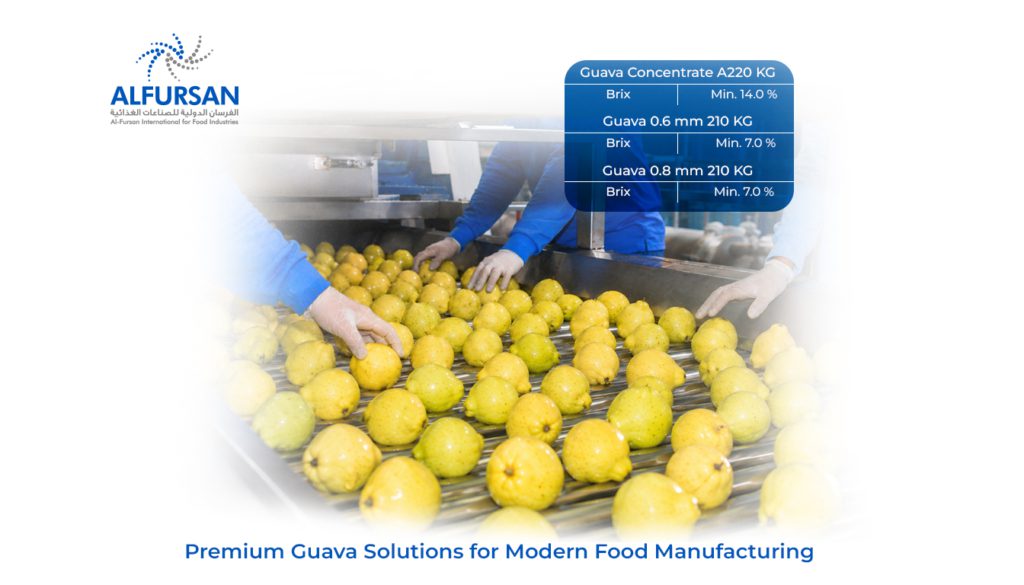
Table of Contents
- Al Fursan International Is a Leading Guava Concentrate Manufacturer in Egypt
- Guava Concentrate Manufacturer in Egypt Serving Industrial Buyers Worldwide
- Technical Specifications
- Industrial Applications
- Production Standards
- What This Means for B2B Buyers
- Wholesale Supply for Formulation and Distribution
- Sustainable and Responsible Production
- Why Buyers Choose Al Fursan
- Summary
- FAQ
Key Takeaways
- Al Fursan supplies aseptic guava concentrate (min. 14.0° Brix) alongside guava puree in 0.6 mm and 0.8 mm particle sizes (min. 7.0° Brix), covering most reconstitution and direct-use needs.
- Our guava concentrate and puree are produced from fresh Egyptian guava, sorted and processed close to harvest to preserve color, aroma, and pulp integrity.
- Typical buyers include beverage manufacturers, dairy processors, bakery and confectionery producers, and distributors building a tropical fruit ingredient portfolio.
- Packaging, drum weight, Brix tolerance, and mesh size should all be confirmed against your formulation before you commit to a purchase order.
- Egypt’s guava harvest and competitive logistics into Europe, the Middle East, and Africa make it a practical sourcing base for buyers looking to diversify supply away from a single origin.
Al Fursan International Is a Leading Guava Concentrate Manufacturer in Egypt
The product and its industrial purpose
Guava concentrate is fresh guava puree that has had part of its water content removed, raising the soluble solids (Brix) so it ships and stores more efficiently. Our guava concentrate carries a minimum Brix of 14.0%, while our guava puree — offered in 0.6 mm and 0.8 mm particle sizes — holds a minimum Brix of 7.0%. Both formats exist because different manufacturers need different things: concentrate suits buyers who reconstitute on-site and want to save on freight and storage, while puree suits buyers who want the fruit closer to its natural state, with less processing before it goes into the final product.
Al Fursan as the manufacturer
We are Al Fursan International for Food Industries, an Egyptian food manufacturing and ingredient supplier. Our guava lines take fresh fruit from local growing regions through washing, sorting, pulping, and either concentration or direct puree finishing, before aseptic filling. As a guava concentrate manufacturer in Egypt, we work directly with growers and control the process from intake to packaging, which gives buyers a single point of contact for specification questions, documentation, and order planning.
Why demand for guava concentrate matters to processors
Guava is a distinctive flavor that is hard to replace with a blend of other fruits, which is part of why demand from beverage and dairy companies has been steady even as some other tropical fruit categories have seen more price volatility. According to data reported from the Food and Agriculture Organization, Egypt ranked among the top global guava producers in 2023, giving processors here a large, established fruit base to draw from rather than relying on imported raw material. For manufacturers building or expanding a guava-flavored product line, that supply depth matters as much as the finished ingredient’s specification sheet.
Guava Concentrate Manufacturer in Egypt Serving Industrial Buyers Worldwide
Our role as a direct manufacturer
Working with a direct manufacturer rather than a trading intermediary changes what you can ask for. We can adjust batch documentation, discuss Brix tolerance on a given lot, and confirm mesh size or drum fill weight directly, because we control the plant floor. That direct relationship also shortens the chain of communication when a buyer needs a certificate of analysis or a food safety document ahead of a shipment.
Primary customers across food and beverage processing
Our guava concentrate and puree go to a mix of buyers: juice and nectar producers who reconstitute concentrate into finished beverages, dairy processors adding guava to yogurt and flavored milk, bakery and confectionery manufacturers using puree in fillings and preserves, and private-label brands formulating tropical fruit products for retail. Distributors and importers who hold inventory for smaller regional manufacturers are another significant part of our customer base.
Wholesale and formulation partnerships
For manufacturers running continuous production lines, a single spot purchase rarely makes sense — most of our guava concentrate and puree moves through standing supply agreements tied to a buyer’s annual formulation volume.
“Buyers rarely ask us for guava concentrate in isolation. They ask how it performs next to their existing tropical fruit lineup, what the Brix tolerance looks like batch to batch, and whether we can hold a production slot during their peak season.” — Al Fursan Production Team
Food manufacturers
Food manufacturers using guava puree in bakery fillings, confectionery, or fruit preparations tend to care most about particle size consistency and color stability after heat processing. Our 0.6 mm and 0.8 mm puree grades are built with that kind of downstream processing in mind.
Beverage producers
Beverage producers reconstituting our guava concentrate into nectar or juice drinks are typically more focused on Brix accuracy, since that number determines how much water they add back and how consistent the finished drink tastes from batch to batch.
Technical Specifications
Buyers sourcing guava concentrate or guava puree should confirm the exact specification against their formulation before ordering, since Brix, particle size, and packaging all affect how the ingredient performs downstream.
| Product | Format | Minimum Brix | Typical Packaging |
|---|---|---|---|
| Guava Concentrate | Aseptic concentrate | 14.0% | 220 kg drum |
| Guava Puree 0.6 mm | Fine particle puree | 7.0% | 210 kg drum |
| Guava Puree 0.8 mm | Coarse particle puree | 7.0% | 210 kg drum |
Under the Codex Alimentarius General Standard for Fruit Juices and Nectars, fruit purée is defined as the unfermented but fermentable product obtained by processes such as sieving, grinding, or milling the edible part of the fruit, while concentrated fruit purée is produced by physically removing part of the water. That distinction is exactly what separates our concentrate line from our puree line, and it’s worth understanding before you compare quotes from different suppliers, since some “concentrate” offers on the market are closer to a lightly reduced puree than a true high-Brix concentrate.
What buyers should confirm before ordering
- Brix tolerance: ask whether the stated minimum is a hard floor or a target range, and how it’s measured (refractometer reading at a stated temperature).
- Particle size: confirm whether 0.6 mm or 0.8 mm puree is the right fit for your equipment and finished texture.
- Packaging and drum weight: verify net weight, drum material, and whether aseptic bag-in-drum or another format is used.
- Shelf life and storage conditions: ask for documented shelf life at ambient versus chilled storage.
- Color and pulp consistency: request a sample or recent certificate of analysis before committing to a large first order.
Industrial Applications
Beverage manufacturing
Guava concentrate is most commonly reconstituted into nectar, juice drinks, and blended tropical beverages, where its Brix level lets formulators calculate water addition and sugar balance precisely. It also works well as a flavor component blended with other tropical fruit concentrates to round out a beverage’s profile.
Dairy applications
Guava puree is used in flavored yogurt, milk-based drinks, and dairy desserts, where its natural pulp adds texture along with flavor. The 0.6 mm grade tends to suit smoother dairy applications, while the 0.8 mm grade can hold up better in products where visible fruit pieces are part of the appeal.
Bakery and confectionery
In bakery fillings, jams, and confectionery, guava puree’s set and spreadability depend heavily on particle size and pectin behavior during cooking, which is why manufacturers in this category usually test both puree grades before finalizing a formulation.
Custom formulations
Some buyers blend guava concentrate or puree with other tropical fruits — mango, passion fruit, or pineapple — to create proprietary flavor profiles. Because we manufacture guava directly, we can discuss Brix and pulp content adjustments for custom blending projects at a formulation stage rather than after a fixed product has already shipped.
Production Standards
Fruit selection
Our guava concentrate and puree start with fresh fruit selected for ripeness and quality at intake, since underripe or overripe fruit affects both Brix and color in the finished product. Fruit that doesn’t meet our intake standards is rejected before it enters the production line.
Processing controls
From washing through pulping, concentration, and aseptic filling, our process is built around holding Brix, color, and pulp consistency within a defined range for each product. Aseptic processing and filling is what allows the finished concentrate and puree to be stored and shipped without refrigeration while maintaining food safety.
Hygiene and traceability
Our production follows the food hygiene framework set out in the Codex Alimentarius General Principles of Food Hygiene (CXC 1-1969), which forms the basis for Good Hygiene Practices and HACCP-based controls used across the food industry. Every batch is traceable back to its intake date and fruit source, which matters if a buyer’s own quality team ever needs to trace a specific lot.
Questions buyers should ask a supplier
- What HACCP or food safety certification does the facility currently hold?
- How is Brix measured and recorded for each batch?
- What is the standard lead time between order confirmation and shipment?
- How is traceability documented if a quality issue needs to be investigated?
- What packaging options exist beyond the standard drum format?
Batch consistency
| Quality Parameter | What We Monitor | Why It Matters to Buyers |
|---|---|---|
| Brix | Measured per batch against product minimum | Determines reconstitution ratio and cost per finished liter |
| Color | Visual and instrumental comparison to reference | Affects finished product appearance and shelf appeal |
| Particle size (puree) | Screened to 0.6 mm or 0.8 mm specification | Determines texture and equipment compatibility |
| Microbiological status | Tested against aseptic processing standards | Supports shelf-stable storage and export documentation |
What This Means for B2B Buyers
Sourcing guava concentrate from an Egyptian manufacturer rather than a trader gives buyers more control over three things that matter in formulation: specification consistency, lead time visibility, and documentation. When you can speak directly with the people running the production line, adjusting a purchase order or resolving a documentation question takes days instead of weeks.
“The buyers who get the most out of working with us are the ones who tell us their formulation goals up front — not just a Brix number, but what they’re actually trying to build.” — Al Fursan Production Team
Sourcing from Egypt also gives international buyers a practical alternative to concentrating all tropical fruit purchasing in a single origin country. Egypt’s guava harvest is large enough to support consistent annual supply, and its position gives manufacturers exporting to Europe, the Middle East, and parts of Africa comparatively short shipping routes.
For procurement teams, the practical takeaway is to plan guava concentrate and puree purchases around your production calendar rather than ordering reactively. Confirming volume needs and Brix requirements a season ahead gives your supplier time to plan fruit intake and production scheduling around your order.
Wholesale Supply for Formulation and Distribution
Bulk purchasing considerations
Buyers purchasing guava concentrate or puree at wholesale volume should plan around drum quantities, container loading efficiency, and storage capacity at the receiving end. A full container load is usually the most cost-efficient way to buy, but smaller manufacturers and distributors can typically arrange partial-container or mixed-product shipments.
Order planning
Because guava has a defined harvest window, placing orders with enough lead time lets us align your production run with fresh fruit intake rather than pulling from limited inventory. Buyers with predictable annual volume are generally better served by a standing agreement than by one-off purchase orders placed close to when they need the product.
Direct supplier vs. distributor
Buying directly from the manufacturer typically means better visibility into specifications and production timing, while working through a distributor can mean smaller minimum order quantities and faster access to inventory already in your region. Which route makes sense depends on your volume, storage capacity, and how much lead time your own production planning allows.
Inquiry checklist
- Target Brix and particle size (if ordering puree)
- Annual or per-shipment volume estimate
- Preferred packaging (drum size, aseptic bag-in-drum, or alternative)
- Delivery destination and required shipping documentation
- Any additional specification requirements (color, pH, or other parameters)
Buyers ready to move forward can request a formal quote with these details, or reach our team directly by phone or email to discuss a formulation before committing to a specification.
Sustainable and Responsible Production
Sourcing questions worth asking
Buyers increasingly ask suppliers how fruit is sourced, how much of the harvest is used, and what happens to processing by-products. These are reasonable questions to raise with any guava concentrate manufacturer in Egypt you’re evaluating, since the answers affect both supply reliability and how a finished product can be marketed further down the chain.
Efficiency and waste considerations
Processing guava close to the growing regions reduces the time between harvest and pulping, which limits spoilage losses and supports more consistent Brix and color in the finished concentrate and puree. Efficient use of the fruit at intake — rather than discarding fruit that doesn’t meet a narrow cosmetic standard but is otherwise sound — is part of running a responsible processing operation.
A shorter distance between the orchard and the processing line is one of the simplest ways to protect fruit quality before it ever reaches the plant.” — Al Fursan Production Team
Certifications and standards buyers should look for
- Food safety management aligned with ISO 22000:2018, the international standard for food safety management systems
- HACCP-based process controls
- Compliance with Egypt’s national food safety regulatory framework, overseen by the National Food Safety Authority established in 2017
- Export documentation appropriate to the buyer’s destination market
How sustainability shapes sourcing decisions
For many B2B buyers, sustainability questions are no longer separate from procurement decisions — they’re part of supplier qualification. Working with a manufacturer that can explain its fruit sourcing, processing efficiency, and food safety framework in plain terms makes that qualification process faster on both sides.
Why Buyers Choose Al Fursan
| Factor | Sourcing from Al Fursan | Sourcing Through an Intermediary |
|---|---|---|
| Specification control | Direct access to production and Brix data | Limited visibility into actual processing |
| Documentation speed | Direct communication with the manufacturer | Requests routed through multiple parties |
| Custom formulation input | Available during production planning | Rarely possible after purchase |
| Traceability | Batch-level, tied to fruit intake | Depends on intermediary’s own records |
| Lead time transparency | Direct scheduling conversations | Subject to intermediary’s own supply chain |
Buyers who source guava concentrate and puree directly from Al Fursan typically report clearer communication during order planning and fewer surprises around lead time, since there’s no additional party between the request and the production floor. That doesn’t replace the value a good distributor can offer for smaller-volume buyers — it simply means the choice between direct sourcing and distributor sourcing should be based on your volume and how much specification detail your formulation team needs.
Summary
Guava concentrate and guava puree remain practical, flavor-stable ingredients for beverage, dairy, and bakery manufacturers looking to add tropical fruit character to their product lines. Al Fursan International, as a guava concentrate manufacturer in Egypt, supplies aseptic concentrate at a minimum of 14.0° Brix alongside 0.6 mm and 0.8 mm guava puree at a minimum of 7.0° Brix, produced from fresh Egyptian fruit under documented processing and hygiene standards. Before placing an order, buyers should confirm Brix tolerance, particle size, packaging, and documentation needs against their own formulation — the specification questions covered in this guide are a reasonable starting checklist for evaluating any guava supplier, not just ours.
For B2B buyers ready to move forward, sourcing directly from the manufacturer generally means faster answers to specification questions and more flexibility around custom formulation discussions than working through multiple intermediaries.
Request a Quote: https://alfursaneg.com/request-a-quote/ | Phone: +201226241057 | Email: info@alfursaneg.com
FAQ
What is the difference between guava concentrate and guava puree? Guava concentrate has had part of its water content physically removed to raise its Brix (soluble solids) above that of the original fruit — our concentrate is a minimum of 14.0° Brix. Guava puree is closer to the fresh, pulped fruit with less water removed — our puree grades are a minimum of 7.0° Brix.
What particle sizes are available for guava puree? We offer guava puree in 0.6 mm and 0.8 mm particle sizes. The finer 0.6 mm grade tends to suit smoother applications like dairy drinks, while the 0.8 mm grade can retain more textural presence in fillings and preserves.
What packaging does guava concentrate and puree ship in? Our standard packaging is aseptic drums — 220 kg for guava concentrate and 210 kg for guava puree. Buyers with different packaging requirements should raise this during the inquiry stage so we can confirm what’s feasible for their order.
How is Brix measured and guaranteed on each batch? Brix is measured using a refractometer against the stated minimum for each product, and results are recorded as part of batch documentation. Buyers can request a certificate of analysis for a given shipment.
Can guava concentrate and guava puree be blended with other tropical fruits? Yes. Many buyers blend our guava concentrate or puree with mango, passion fruit, or pineapple to build a proprietary flavor profile. Because we manufacture guava directly, we can discuss blending and Brix considerations during your formulation planning rather than after the product has already shipped.
Why source guava concentrate from Egypt instead of other producing countries? Egypt has a large, established guava harvest, which supports consistent annual supply, and its geographic position offers relatively short shipping routes to Europe, the Middle East, and parts of Africa compared with some other major guava-producing regions.
What is the minimum order quantity for guava concentrate or puree? Minimum order quantities depend on packaging format and shipping method. Buyers evaluating volumes below a full container load should raise this directly with our team so we can confirm what’s practical for a given order.
What documentation is provided with each shipment? Standard documentation includes a certificate of analysis and export paperwork appropriate to the destination market. Buyers with additional documentation requirements, such as specific food safety certificates, should confirm these needs at the inquiry stage so they can be arranged ahead of shipment.